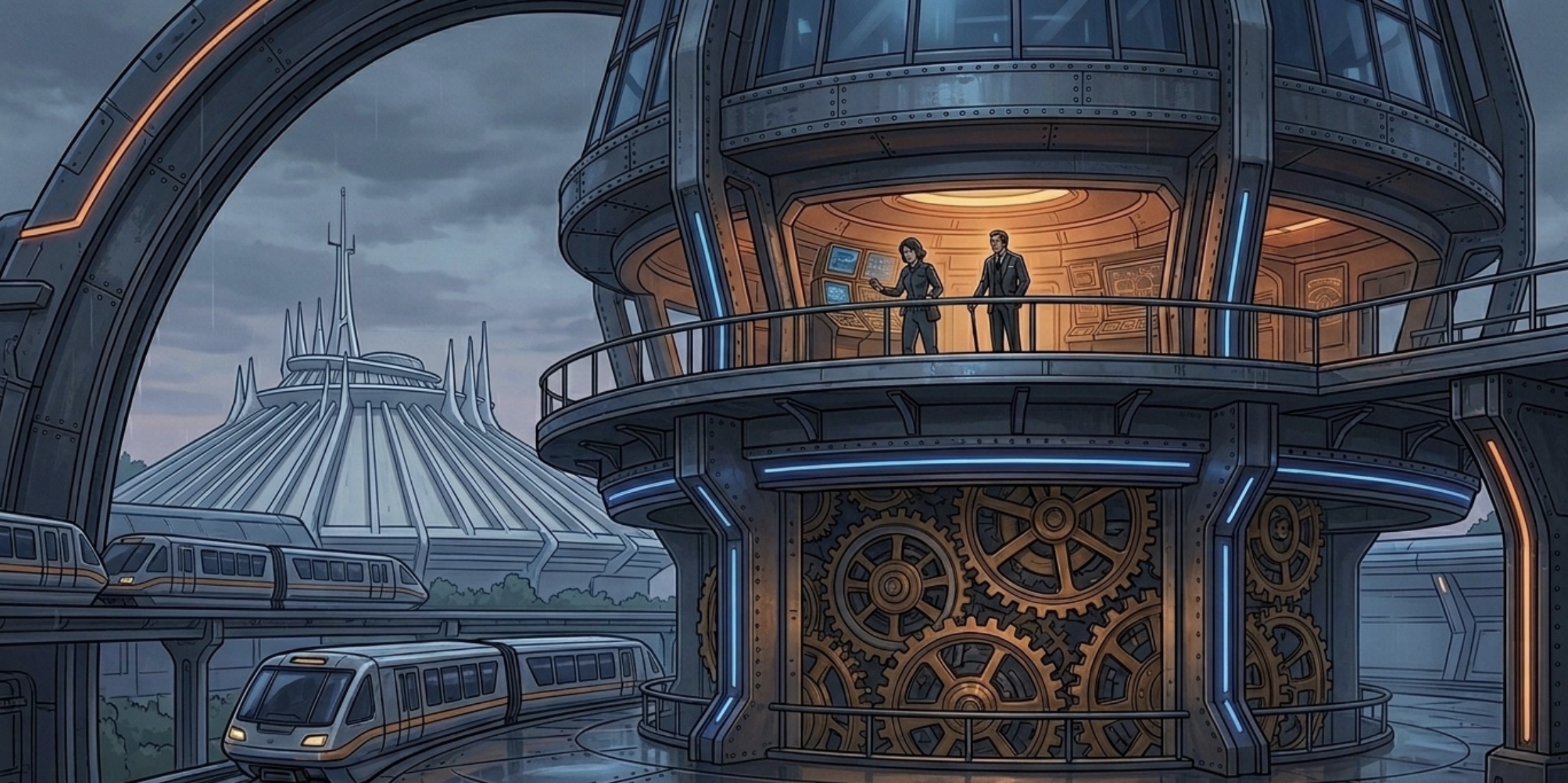
My alarm rang as it did every day. Three beeps followed by the sounds of Tomorrowland Compliance Radio (WCTR). The unoffensive, smooth synthesized tracks and automated messages on civil order and civic pride was usually reserved for the factories or public squares, but my dad had worked with Morris Sotto, Director of Transit Operations at the TTA and he cut a deal to get it on my personal radio feed. He thought it would help keep me properly motivated for my career in public service. My mom snuck WZORK - Deep Space Free Radio onto my feed shortly after.
I've worked as a Track Operator at the Tomorrowland Transit Authority for the last seven rotations. I know exactly what to expect and when to expect it. Cars depart every twelve seconds. They enter the tunnels at twenty miles per hour. They emerge into the Cosmic Promenade precisely eighty-four seconds later. The entire Tomorrowland Transit Authority operates on a rhythm of absolute, mathematically enforced predictability.
It's the kind of efficiency my dad always admired about Tomorrowland. The consistency was something he drilled into me. The pattern became a comfort.
Every once in a while I have had the urge to do something different. Break the monotony. It just never felt like the right time. This was supposed to be the perfect future. It didn't seem like it to me. I felt like I was stuck on one of those TTA tracks, running the same route over and over with no surprises.
The tracks did not change. The tracks did not rock the boat.
The tracks did not create passengers out of thin air. Or, at least, they shouldn’t.
The shift started like any other Monday morning. The first light of dawn was just hitting the spires of Star Port 75, casting shadows across an empty Rocket Tower Plaza. I was stationed at the main control console for Platform 1, sipping my cup of caf and monitoring the morning reports.
Car 12 was the first to complete the full loop—a routine track inspection circuit to clear any debris before the morning rush of tourists and corporate units arrived. I had personally watched Car 12 glide out of the station completely empty. My monitors confirmed zero weight distribution across the floorboards.
Yet, six minutes later, as Car 12 rounded the final curve from the Tomorrowland Museum bypass and clicked into the off-load bay, the weight sensors suddenly spiked by exactly 165 pounds. I blinked, wiping the sleep from my eyes, and looked up from the console. Sitting perfectly upright in the middle blue bench was a man.
He hadn't been there when the car passed the XS Tech power grid. He hadn't been there when it cut through the upper rafters of Cosmic Ray's. But there he sat, entirely calm, resting both hands on a walking cane.
He was dressed in a suit that looked mid-century, paired with a silver tie clip shaped like an hourglass. In a city where everyone was currently rushing around in utility jumpsuits or intergalactic fashion, his style stood out like a meteor trail in a clear night sky. As the car slowed to a halt, he didn't look around in confusion. He simply adjusted his cuffs, stood up, and stepped onto the platform.
My training manual explicitly states that unauthorized track intruders are to be immediately reported to Sector Security or a Corporate Compliance officer. But there was an aura about him that made my hand freeze over the comm-link. He didn't look like a trespasser. He looked like he owned the rails.
He walked directly toward my operator box. His shoes made no sound on the platform. When he reached the glass pane, he offered a polite, professional nod. His eyes were a striking and unusually bright for the early morning light.
He didn't look at my console, nor did he look at the city around him. He looked directly at me, leaned slightly on his cane, and asked a single, quiet question:
"Tell me, Operator—is now the time?"
Before I could process the words, let alone formulate an answer, he gave another polite nod, turned on his heel, and walked down the exit ramp toward the promenade. I practically threw myself out of the operator booth, shouting for him to wait, but by the time I cleared the turnstiles and looked down the ramp, the plaza was completely empty. The morning sun had just broken over the horizon. He was gone.
I stood there in the silence of the early morning ringing in my ears. Is now the time? It was such a simple phrase, yet it rattled around the inside of my head like a loose gear in a high-velocity turbine.
I looked back at my console, where WCTR was currently broadcasting its morning "Progress Profile." The synthetic voice cheerily reminded us that "the future is just a dream away, provided you stick to your designated sector." We were always being told about progress. Morris Sotto’s memos always preached it. But his version of progress wasn't a march forward—it was a circle. It was a carousel that rotated through the exact same four quadrants of production, compliance, efficiency, and rest, returning us right back to where we started every single morning.
I leaned against the railing of the platform, looking out at the waking city. I thought about how my mother used to talk about the old days. She used to tell me stories about an ancient, mid-century philosopher who believed that progress wasn't an automated grid, but a living, breathing thing driven by individual dreamers. She said he believed that every time a person stepped out of their comfort zone, a whole new world opened up.
I had spent my entire life being terrified of stepping out of line. I liked the autumn of predictable routines; I feared the unpredictable winter of change. But as I watched the first morning TTA train glide away, its linear induction motors humming that familiar rhythm, I looked down at my own hands. They were stained with the lubricant of the track switches. I was a part of the machine. I was the one keeping the carousel turning.
But the stranger's gaze had been different. His eyes didn't look like they belonged to a unit of Metropolis. They looked like they had witnessed decades of centuries turning. They looked like they had seen eras change, from the first spark of gas lamps to the neon spires of Star Port 75. He wasn't asking if the grid was ready. He was asking if I was ready.
If I didn't make a move now—if I didn't choose to alter my own track alignment—when would I? There would always be another shift. There would always be another automated sweep. There would always be a reason to wait for a better tomorrow instead of making one today.
The creeping realization washed over me, warm and sudden, like a blast of heat breaking through the climate-controlled Tomorrowland Towers. The nagging feeling that had been pulling at the edges of my mind for months finally locked into place with a click.
The stranger didn't come to ride the TTA. He came to give me my cue.
I walked back into the operator booth, my boots striking the floorboards with a new weight. I didn't reach for the security comm-link to report the intruder. Instead, for the first time in my career, I flipped the radio feed to WZORK, reached for my personal data-pad, bypassed the official logging software, and opened a blank, untraceable transmission queue.
My hands were shaking, but my mind had never been clearer.
Now is the time.