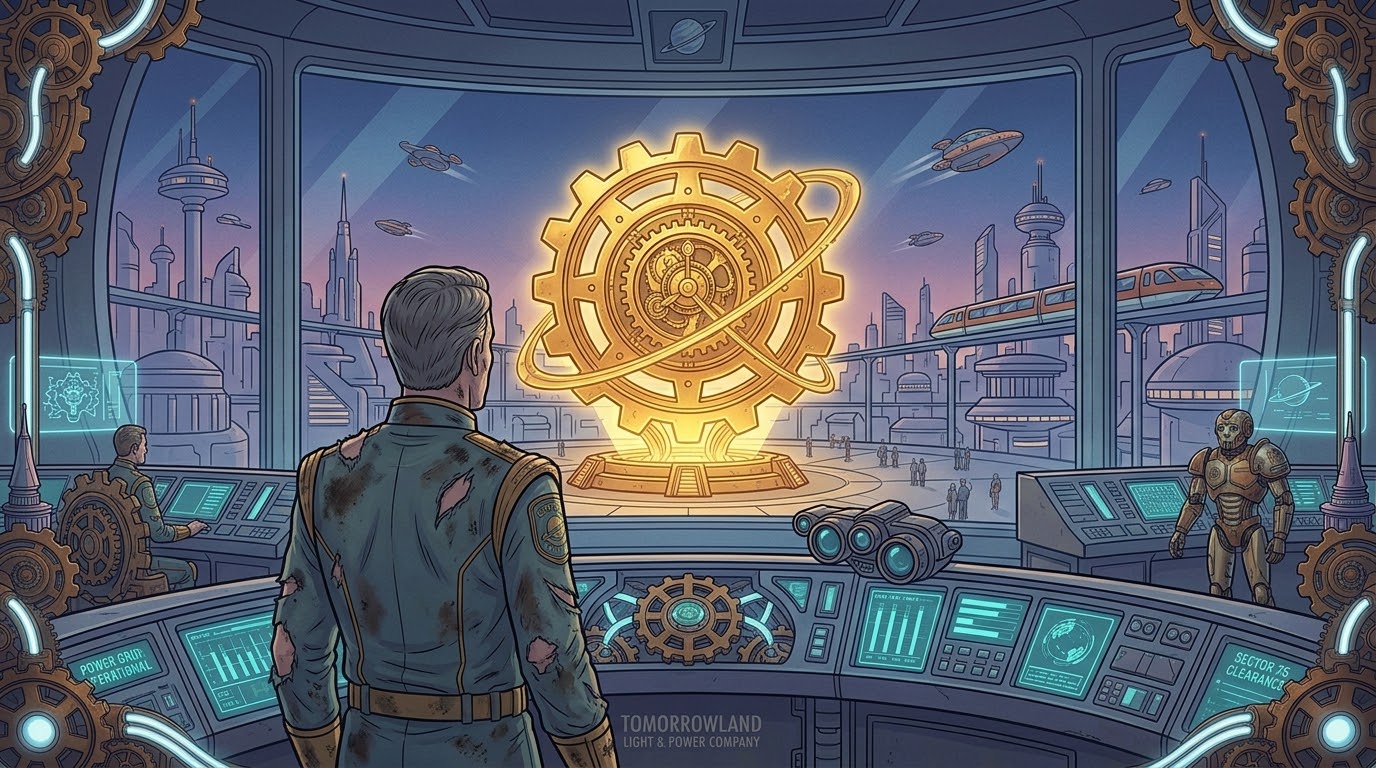
The Power Distribution Control Room smelled like burnt flux-paper and fear.
Navin Litened had never been so glad to smell anything in his life.
He’d pictured this walk about four hundred times, hiding in the storm culverts under the Cosmic Promenade. He'd pictured the clean control room. Him striding back into his office, uniform in show-ready condition, with a disciplinary memo already drafted for whoever had let things fall apart in his absence. Instead he arrived soaked, torn, with a name patch hanging on by one thread, and the room completely fallen apart.
“I don’t care what the order says, I am not dumping the East Grid without a...” Merril had a handset in one fist, a clipboard in the other, and was losing an argument with both.
“Administrator’s authorization doesn’t mean anything if the Administrator isn’t here, that’s the entire...” Merril stopped mid-sentence and stared.
The room went quiet the way a room goes quiet when it has genuinely stopped believing in something and that something walks back in anyway.
“Somebody,” Navin said, into the silence, “tell me who gave the order to cut power to this city, and tell me in fewer than fifteen words, because I have had a very long month and I would like to skip the part where everyone explains their feelings first.”
It took Merril nine.
“Premier’s office. Full lockdown. Grid-wide. An hour ago.”
Navin was already moving toward the main board, already unbuttoning a cuff that didn’t need unbuttoning. He was feeling something settle back into place in his chest that he hadn’t realized had been missing for three weeks — not confidence, exactly. Function. The particular calm of a man who has spent his entire career believing that if you just look hard enough at a problem, it resolves into switches. Switches can be thrown correctly or incorrectly, and he has always, always known which was which.
“A lockdown draws down consumption,” he said, scanning the board. “It doesn’t draw up generation. Why is Reactor Four running at a hundred and ten percent of what it should be for a lockdown?”
Nobody answered right away, because nobody had asked the question out loud yet. As they realized, the room’s collective stomach dropped about four inches all at once.
Oben got there first, because Oben had spent weeks in the field learning to notice things TL&P training never covered. “It’s not going out to the grid,” he said slowly, tracing a line on the board with one finger. “Load’s spiking, but Metropolis draw’s flat. It’s being pulled somewhere. Somewhere that isn’t on this board at all.”
Merril’s hand found the emergency shutters release without him seeming to decide to reach for it, and outside the window, Tomorrowland’s skyline did the thing Navin had been dreading since the Complex, the thing he’d seen from underground through a storm grate and told himself he’d imagined: the Grand Chronopolis, dormant for longer than anyone alive had a memory of, was awake. A gold light pulsing up through the seams of Rockettower Plaza like something under the city had finally decided to open its eyes.
“That’s not a lockdown,” Navin said quietly. “That’s a power feed.”
He looked at Merril, and at Oben, and did the thing he had spent thirty-one rotations training himself never to do on the clock, which was make a decision he could not fully justify with a memo.
“Hold the East Grid. Don’t send it anywhere the Premier’s office asks for it, not one relay, not until I say so — and if anyone from that office calls, you haven’t seen me.” He was already pulling his jacket off, already reaching for the maintenance-tunnel access panel maintenance kept insisting they weld shut. If he remembered correctly, the tunnel ran straight under the Promenade to the base of the Chronopolis itself. “Oben. Do you think you can open this?”
Oben grinned and pulled a plasma torch out from behind his back.
Under the city, the tunnel walls hummed like something alive, and the closer they got the more the hum sounded less like current and more like breathing.
They came up through a service grate into chaos already in progress.
The chamber at the base of the Grand Chronopolis had never, as far as any TL&P blueprint recorded, actually opened. It was listed on every schematic Navin had ever signed off on as inert, historical, do not access, and he had signed off on that description without once wondering why an entire city had collectively agreed not to ask. Now it yawned upward into gold light while enormous brass gearwork the size of buildings articulated around a central housing that looked like a keyhole built for a key the size of a starship. Around its base was a wildly outmatched collection of people Navin recognized was doing everything in its power to keep it from turning any further.
Kaelen and Orin had wedged a large Martian pry-bar into a relay housing and were leaning on it with the specific stubbornness of people who had spent their whole lives being ignored by the official record and had decided, apparently, that tonight was the night that stopped. Sprock was somewhere above them on the gearwork itself, doing something with a cable that was probably not covered by any safety regulation Navin had ever written. Nora had a portable relay board wired directly into a junction box and was shouting numbers at Phoebe, who was shouting different numbers back. Stro was flat on his back under a conduit with sparks raining down on him, laughing...for some reason.
In the middle of it all, one hand braced against a control column that was actively trying to shake itself apart, hair plastered to her face with sweat and gear-oil, was his daughter.
Navin’s whole month, every culvert and every cold night and every hour spent telling himself the safest thing he could do for his daughter was stay hidden until this all blew over — all of it evaporated at once, replaced by a much older and much simpler instinct that had nothing to do with being an Administrator at all.
“ISLA—”
She turned, and for one full second neither of them said anything useful.
“You look terrible,” she said.
“You’re glowing. Actually, it’s the panel behind you,” he responded. It was, somehow, exactly enough of a reunion for both of them, because there wasn’t time for more.
Tomorrowland Premier Lucien Voss stepped out of the light.
He looked, Navin thought, exactly as congenial as ever. Not a hair disturbed. Hands folded. The Premier of Tomorrowland regarded the wreckage of his private chamber, the ragged little coalition trying to stop him, and his missing Administrator standing in the middle of it. He displayed the faintly disappointed patience of a man reviewing a budget request he intends to deny.
“Navin,” he said warmly. “You’re late. I’d nearly given up on you joining us for the good part.”
“You’re not just covering up what the Chronopolis holds,” Navin said. He was still doing the arithmetic even as he said it, the way he did arithmetic on everything, and it kept coming out the same impossible way. “You’re not protecting a two-thousand-rotation secret. You’re trying to use it.”
“Very good.” Voss did not look surprised so much as mildly pleased, the way he looked when a subordinate finally justified a promotion he’d already decided on. “Do you know how long it takes to build an organization patient enough to spend generations manufacturing a grievance, Navin? The Sons of Phobos believe they’re owed recognition. A place in the history books. How touching. How useful.” He said it without a trace of Martian in his voice, without a flicker of the old Phobian formality Thorne wore like a second skin. Off to one side, half-shadowed by a fallen gear housing, Thorne himself went very still, hearing for the first time exactly what he had actually been part of.
“They wanted a footnote fixed,” Voss went on, pleasant as ever, stepping toward the control column. “I want what’s actually behind the footnote. A drive system that mapped an entire species across the dark between worlds. Do you have any idea what a Premier could do with that, once the rest of the galaxy learns Tomorrowland has it?”
“You’d hurt people,” Isla said. “You’re already hurting people.”
“I’m building,” Voss said, and for the first time something cold slid under the warmth. “Which is more than this city has done in two thousand rotations, hiding a debt in a torn photograph rather than admit what it owes.” He looked past her, to Navin, and his voice went soft and reasonable again, the tone of a man offering someone a very simple way out. “The grid is destabilizing under this draw, Administrator. You can feel it, I know you can — you designed half those failsafes yourself. Cut the feed now, mid-cycle, and this whole housing overloads. Not just this chamber. The East Grid. The Promenade. Every home still running lights past curfew.” He nodded, almost kindly, toward Isla and the others. “You know your duty. You’ve spent thirty-one rotations proving you know it better than anyone. Order your people off that column, let the sequence finish, and I promise you — this city keeps its lights on tonight.”
Navin looked at the board Nora had jury-rigged into the wall, and understood, all at once and completely, that Voss wasn’t lying. The math was real. Cutting the feed now, with the sequence this far along, would black out a third of Tomorrowland in the middle of the night, on his authorization, against every protocol he had spent his career enforcing.
He looked at his daughter’s hand, still braced white-knuckled against the shaking column.
He thought about thirty-one rotations of believing that the right answer was always the one you could defend in a memo.
“Isla,” he said. “On my mark, pull everything you’ve got off that column and get clear.”
“Dad—”
“I said on my mark.”
He walked to the master relay Merril had once shown him how to key with his own command code — a fail-safe built, he now realized with something between horror and grim pride, for precisely a moment like this, a moment nobody had ever expected an Administrator to actually choose — and he put his hand on it, and for one half of one second he let himself feel exactly how many homes were about to go dark because of what he did next.
“You said I know my duty,” he told Voss. “I do. It was never to the grid.”
He threw the breaker.
The Grand Chronopolis did not explode. It simply, all at once, stopped — a groan of brass winding down through octaves too low to be comfortable, gold light guttering out of the seams of Rotation Zero like a held breath finally released, and around the chamber, every relay Nora, Sprock, Kaelen, and Orin had spent the last twenty minutes fighting went dark in the same instant the housing did, taking the fight out of Voss’s hands as cleanly as pulling a card from underneath a very tall building of cards.
Voss did not go quietly. But he went — Thorne saw to that personally, with an expression that suggested two thousand rotations of grievance had just found a much more specific target, and the Loyal Order, for once in its long marginalized history, got to be the ones who marched the villain out in front of witnesses instead of writing the footnote about it afterward.
A third of Tomorrowland did go dark that night, exactly as Voss had promised, and exactly as Navin had feared. And then something happened that thirty-one rotations of protocol had never quite prepared him to expect: the city, faced with an unscheduled blackout for the first time in living memory, did not descend into the chaos every one of his contingency plans assumed. Neighbors found glow rods. The TTA ran a skeleton auxiliary loop by hand-crank for two grid-cycles, Nora grinning the entire time like she’d been waiting her whole life to be useful in exactly this specific, absurd way. Someone got out a Cometcaster on the Promenade. It was, several residents said afterward, one of the nicer nights anyone could remember.
They gave Navin the Premiership eight days later. The League of Planets had first had to sort out exactly how much of the last several decades Lucien Voss had personally falsified. Navin argued against it for three of those eight days, on the grounds that he was, technically, still an escaped person of interest with a torn uniform and questionable paperwork. The League pointed out that he was also the only person in the entire chain of command who had thrown a breaker knowing exactly what it would cost him, which struck most of them as a fairly relevant qualification.
His first act as Premier was to authorize the restoration of a photograph in the Hall of History — the whole thing, four faces where there had only ever officially been three, John and Sarah’s people finally standing where they’d always stood, in the light, where anyone could see them.
His second act was considerably less official. He found Isla on the observation deck above the Chronopolis, now dark and still and no longer humming with anything more sinister than the ordinary tired creak of very old machinery settling.
“You’re going to be terrible at this,” she told him, not looking up. “You hate paperwork.”
“I’ve heard I’ll have people for that.”
“You’ll fire the people. You’ll insist on reading every memo yourself.”
“Probably,” he admitted.
She finally looked over at him — thirty-one rotations of Administrator, three weeks of fugitive, eight days of Premier, and somewhere underneath all of it, for the first time either of them could remember, just her father, standing in the light instead of managing it.
“For what it’s worth,” Isla said, “I always knew you’d pick us. Eventually.”
Navin looked out at Tomorrowland, lights coming back on grid by grid across the skyline, ordinary and glowing and entirely, finally, his to protect the right way.
“So did I,” he said. “It just took me thirty-one rotations to remember I was allowed to.”